Broken Key Stuck in a Lock in Arlington: Extraction & What NOT to Do
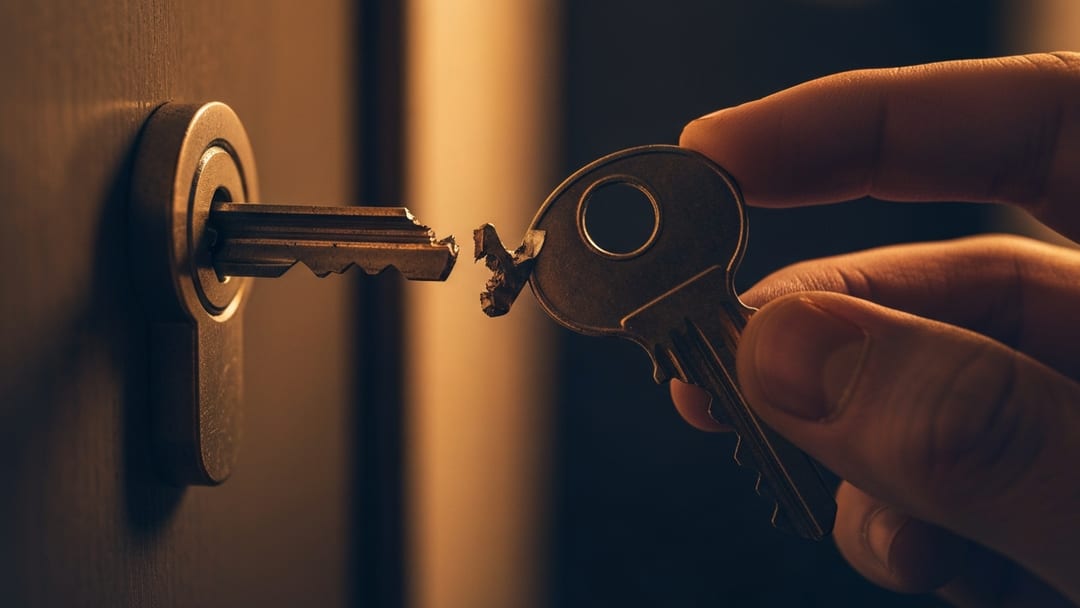
Quick answer: As of July 2026, broken-key extraction in Arlington typically runs $75–$150 as a stand-alone service call. A broken key in a lock or ignition is a quick extraction for a mobile locksmith using proper extractor tools — and an expensive cylinder replacement if you force it. Do not use super-glue, pliers, or another key to push the fragment deeper. Call or text Arlington TX Locksmith at (817) 330-5762 for a technician who can pull the piece cleanly, test the lock, and cut a replacement on site. Keys snap because they are worn or the cylinder is stiff, both of which the locksmith can address so it does not happen again.
Why keys break — and why it is rarely your fault
Keys do not snap at random. They break for two predictable reasons: the key is worn or thin, or the lock it goes into is stiff and dry. A key is a small piece of soft metal that gets a little thinner every time it slides across the pins. Years of daily use wear grooves and weak points into it, and one day a normal turn is enough to finish it off. A bent key, or a cheap copy of a copy that was never cut quite right, is even more fragile.
The other half of the equation is the lock. A cylinder that has gone stiff — from dirt, corrosion, a dry mechanism, or a worn internal part — forces you to push and twist harder than you should, and that extra torque is what actually snaps the blade. So when a key breaks, it is usually the end of a slow process, not a single mistake. A key that has been getting harder to turn for weeks is a warning sign; the break is just the moment it finally gives.
Knowing this changes what you do next. Because the cause is mechanical, the fix is mechanical: extract the fragment, then address whichever side of the equation failed. The Associated Locksmiths of America treats both broken-key extraction and lock servicing as standard tasks in the trade, performed with proper tools — which is exactly why the wrong DIY move does so much damage.
North Texas weather plays a quiet role here, too. Arlington summers are hot enough to bake exterior hardware all day, and the metal in a lock expands and contracts with that heat; winters bring the occasional freeze that can stiffen a cylinder overnight. Garage-door entry locks, gate locks, and back-door deadbolts that sit exposed to the elements collect dust and grit far faster than an interior door. The result is that the locks most likely to snap a key are usually the ones outside, in the weather, that you use without thinking — which is also why a key that has started to stick is worth mentioning to a technician before it strands you.
What NOT to do (the moves that turn a $0 fix into a new cylinder)
The instinct when a key breaks off in a lock is to get it out fast, and that instinct causes most of the expensive damage. Here is what to avoid, and why each one backfires.
Do not use super-glue. Dabbing glue on the broken stub to "weld" it to the piece inside almost never works and frequently glues the fragment to the internal pins, jamming the whole cylinder so it has to be drilled and replaced. Do not jam in pliers or tweezers from the front — there is rarely anything to grip, and forcing them in pushes the fragment deeper and scratches the pin chambers. Do not insert another key to "push it out"; you will only drive the broken piece further into the cylinder, past the point where a clean extraction is possible.
And do not force the lock to turn with the fragment inside. This is especially true for an ignition: the National Highway Traffic Safety Administration notes that modern vehicles rely on transponder and electronic key systems, so a key snapped in an ignition can involve the immobilizer and wiring, not just a mechanical cylinder. Forcing it risks a repair far larger than the broken key. The pattern across all of these is the same — improvised force converts a quick extraction into a destroyed cylinder. Leave the fragment where it is and call someone with the right tool.
How a locksmith actually removes a broken key
Professional extraction is fast and undramatic when nothing has been forced first. The locksmith uses a thin, hooked extractor tool — purpose-built for this exact job — that slides alongside the broken blade, catches the cut grooves, and draws the fragment straight back out the way it went in. There is no drilling, no glue, and no damage to the pins when the piece comes out cleanly. The Associated Locksmiths of America recognizes this as a standard trade task, and a technician who does it regularly can often clear a fragment in minutes.
Extraction is only half the visit, though. Once the broken piece is out, the locksmith tests the cylinder to confirm it still operates correctly, then cuts you a fresh replacement key on site — key cutting being one of the core skills the U.S. Bureau of Labor Statistics catalogs under the locksmith occupation. If the cylinder was the underlying cause — stiff, worn, or dry — the technician can service or repair it so the next key does not meet the same fate. That is the part DIY can never deliver: not just removing the symptom, but fixing the lock that broke the key.
If the break happened in a car ignition, the job may extend further. With transponder-equipped vehicles, the replacement key often has to be cut and programmed to the car's system, which a mobile automotive locksmith can handle on site. The point is that a real fix addresses the whole problem — fragment out, lock checked, working key in your hand — rather than the partial, damaging job that pliers and glue produce.
The reason this works so cleanly is that the technician is not improvising. A purpose-built extractor is designed for the exact geometry of a key blade sitting in a cylinder, and the locksmith has done it enough times to read how the fragment is seated before pulling. That is the whole gap between a professional and a panicked DIY attempt: the professional removes the piece without adding any new damage, then verifies the lock and hands you a working key, while the DIY attempt usually pushes the fragment deeper or scars the pins. When you call an Arlington locksmith for a broken key, you are paying for that clean, no-collateral-damage outcome — fragment out, lock intact, replacement cut — not just for the few minutes the extraction itself takes.
What broken-key extraction costs in Arlington
Extraction is priced like any honest mobile service: a base service call quoted up front, plus a night or holiday surcharge if it applies. As of July 2026, typical Arlington-area ranges look like this — these are typical DFW ranges, not fixed quotes, and the all-in number should be confirmed on the phone before dispatch:
| Job | Typical Arlington range (2026) |
|---|---|
| Broken-key extraction (door lock or deadbolt) | $75–$150 |
| Extraction plus rekey of the affected cylinder | $120–$220 |
| Extraction from a car ignition | $120–$250 |
When no force has been used first, the fragment usually comes out quickly and the bill stays simple. The complication — and the cost — appears when the cylinder was damaged before the locksmith arrived, whether by the original break or by a DIY attempt to fix it. A scratched, jammed, or drilled cylinder needs repair or replacement, and that is exactly why the "what not to do" list above is also a cost-control list.
The Federal Trade Commission's guidance is the safeguard here: get a written estimate before work begins, and be wary of a price that seems too good to be true. For a broken-key job that means confirming the all-in price for extraction on the phone, and getting any additional cost clearly stated if the technician finds cylinder damage on arrival. A trustworthy Arlington locksmith separates "extraction" from "repair" on the quote so you can see what you are paying for, rather than folding everything into one vague emergency number.
Arlington is a large, spread-out city, so as with any mobile call your ETA reflects dispatch distance and traffic — a job near the UTA campus is a different drive than one off the I-20 corridor. Ask for the live ETA along with the price. And if a particular lock keeps eating keys, raise it with the technician: ongoing lock repair or a cylinder swap is cheaper than a string of broken keys and repeated service calls.
When the key breaks in a car ignition
A key that snaps in a door lock is one problem; a key that snaps in a car ignition is a more involved one, and it is worth understanding why before you start pulling at it. The ignition cylinder sits deep in the steering column, surrounded by wiring and, on modern vehicles, tied into the electronic systems that the National Highway Traffic Safety Administration notes are now standard. A fragment lodged in there is harder to reach than one in a deadbolt, and forcing it risks the column and the immobilizer, not just a simple lock.
Extraction still comes first. A mobile automotive locksmith uses the same family of slim extractor tools to draw the broken piece out of the ignition without dismantling the column, then checks that the cylinder still turns correctly. The added step, for most cars built in the last couple of decades, is the key itself: because the vehicle relies on a transponder chip to start, a plain mechanical copy will turn the ignition but not start the engine. The replacement key has to be both cut to the right pattern and programmed to the car's system, which a properly equipped mobile locksmith can do on site.
This is also why the "what not to do" rules matter even more for an ignition. Super-glue near an ignition cylinder, or jamming a screwdriver in to fish out the fragment, can damage a component that is expensive and time-consuming to replace — far beyond the cost of the broken key. If your key has snapped in the ignition, the safe move is to leave the fragment where it is, not turn or jiggle anything further, and call a locksmith who handles automotive work and can quote the extraction and any key programming up front, the way the Federal Trade Commission advises for any lock job.
How to keep a key from breaking in the first place
The cheapest broken-key extraction is the one you never need, and a few habits make a snapped key far less likely. The first is to retire worn keys before they fail. If you can see that a key has gone thin, shiny, or slightly bent — or if it is a copy of a copy that has never quite worked smoothly — have a fresh one cut from the original or from the lock itself. Key cutting is one of the core skills the U.S. Bureau of Labor Statistics catalogs under the locksmith trade, and a clean new key cut to the right depth is dramatically stronger than a tired one.
The second habit is to listen to your locks. A deadbolt or door lock that has started to stick, grind, or require a wiggle to turn is telling you it needs service. Forcing a stiff cylinder is the single most common way keys break, so the moment a lock starts fighting you is the moment to address it — not after the key is already in two pieces. A small amount of the right dry lubricant, applied by someone who knows what a lock can and cannot tolerate, often restores a sticky cylinder to smooth operation; the wrong lubricant can gum it up further, which is why this is worth doing properly.
Third, do not use your house or car key as a tool. Prying open packaging, scraping at a sticker, or using a key as a makeshift screwdriver introduces exactly the kind of bending stress that creates a weak point. Keys are precision-cut for one job. Treat them as the small, breakable pieces of metal they are, replace them when they show wear, and service the locks that start to stick, and you will spend a lot less time waiting for a technician to fish a fragment out of a cylinder on a hot Arlington afternoon.
It is also worth keeping a spare made before the original gives out, especially for a car. A worn transponder key that finally snaps in the ignition is far more expensive to replace from nothing than to copy while it is still in one piece, because the replacement has to be cut and programmed to the vehicle. The Associated Locksmiths of America treats cutting a duplicate from a sound original as routine, low-cost work — the kind of small, planned step that turns a future emergency into a non-event. The pattern across all of this is the same: a key in good condition, a lock that turns smoothly, and a spare on hand are cheap insurance against the much larger cost and inconvenience of a fragment stuck deep in a cylinder.
"Get an estimate in writing before you agree to any work, and be wary of a price that seems too good to be true."
— U.S. Federal Trade Commission, Consumer Advice — Avoiding Locksmith Scams
Sourced statistics
- The Associated Locksmiths of America recognizes broken-key extraction and lock servicing as standard skilled tasks within the trade, performed with purpose-built extractor tools rather than improvised force. — Associated Locksmiths of America (ALOA) (2024)
- The U.S. Bureau of Labor Statistics tracks locksmiths and safe repairers as occupation 49-9094, confirming that key cutting and cylinder repair are recognized trade skills with a documented labor basis. — U.S. Bureau of Labor Statistics (OEWS) (2024)
- The National Highway Traffic Safety Administration notes that modern vehicles rely on transponder and electronic key systems, so a key that snaps in an ignition can involve more than a simple mechanical fix. — U.S. National Highway Traffic Safety Administration (NHTSA) (2024)
- The Federal Trade Commission advises consumers to get a written estimate before any locksmith work begins, which protects against inflated charges when a simple extraction is exaggerated into a major repair. — U.S. Federal Trade Commission — Consumer Advice (2023)
Related services
Need that broken key out today?
Arlington TX Locksmith handles broken key extraction across the city, from the UTA area to the I-20 corridor. Call or text (817) 330-5762 for an up-front price and a live ETA — or text a photo of the lock and the snapped key to (817) 330-5762 and we will send back a quote by message.
Frequently asked questions
How does a locksmith remove a broken key from a lock in Arlington?
A locksmith uses a slim extractor tool to grip the broken fragment and draw it straight out, then tests the cylinder and cuts a replacement key on site. It is usually a quick fix when no force has been used first.
What should I NOT do when a key breaks in the lock?
Do not apply super-glue, jam in pliers, or push the fragment deeper with another key. Each of these can wedge the piece, scratch the pins, or break the cylinder, turning a simple extraction into a costly replacement.
Why do keys break in locks and ignitions?
Worn or thin keys, bent blades, and stiff or dry cylinders all raise the odds of a snap. A key that is getting harder to turn is a warning sign — have the lock serviced before it strands you.
How much does broken-key extraction cost in Arlington?
Extraction is priced as a base service call quoted up front. If the cylinder was damaged by force before the locksmith arrived, repair or replacement adds to that — another reason not to DIY it.
Can a locksmith fix a key broken in a car ignition?
Yes. A mobile automotive locksmith can extract the fragment and, for transponder-equipped vehicles, cut and program a replacement key on site, since a snapped ignition key can involve the car's electronic system, not just a mechanical cylinder.
Sources cited
- Associated Locksmiths of America (ALOA) — Find a Locksmith / Professional Standards (2024)
- U.S. Federal Trade Commission — Consumer Advice — Avoiding Locksmith Scams (2023)
- U.S. Bureau of Labor Statistics (OEWS) — Occupational Employment & Wages, 49-9094 Locksmiths and Safe Repairers (2024)
- U.S. National Highway Traffic Safety Administration (NHTSA) — Vehicle Theft Prevention (2024)
- Texas Department of Public Safety, Regulatory Services Division — Private Security Program — locksmith company licensing (2024)
- U.S. Census Bureau — QuickFacts — Arlington city, Texas (2024)